Listen on Your Favorite App
Episode description
James Villarrubia went from building AI for NASA's drone and aerospace programs to becoming CTO of a travel tech company. In this episode, he and Mo get into why curiosity might be the most important skill in the AI era, what happens to our brains when we stop pushing back on the answers we get, and why the people most resistant to AI might actually be seeing something the rest of us are missing.
Meet the guest

James Villarrubia
James Villarrubia is an accomplished CTO and applied AI expert. As Group CTO of AnyRes, he leads AI and technology across four global travel brands driving ~$3B in annual bookings, redefining the travel experience for both customers and operators. Previously, he was a Presidential Innovation Fellow with NASA Aeronautics, where he helped develop sustainable aviation and next-generation AI solutions. He also brings senior policy and portfolio experience from the White House, DOJ, and DOD.
Full transcript
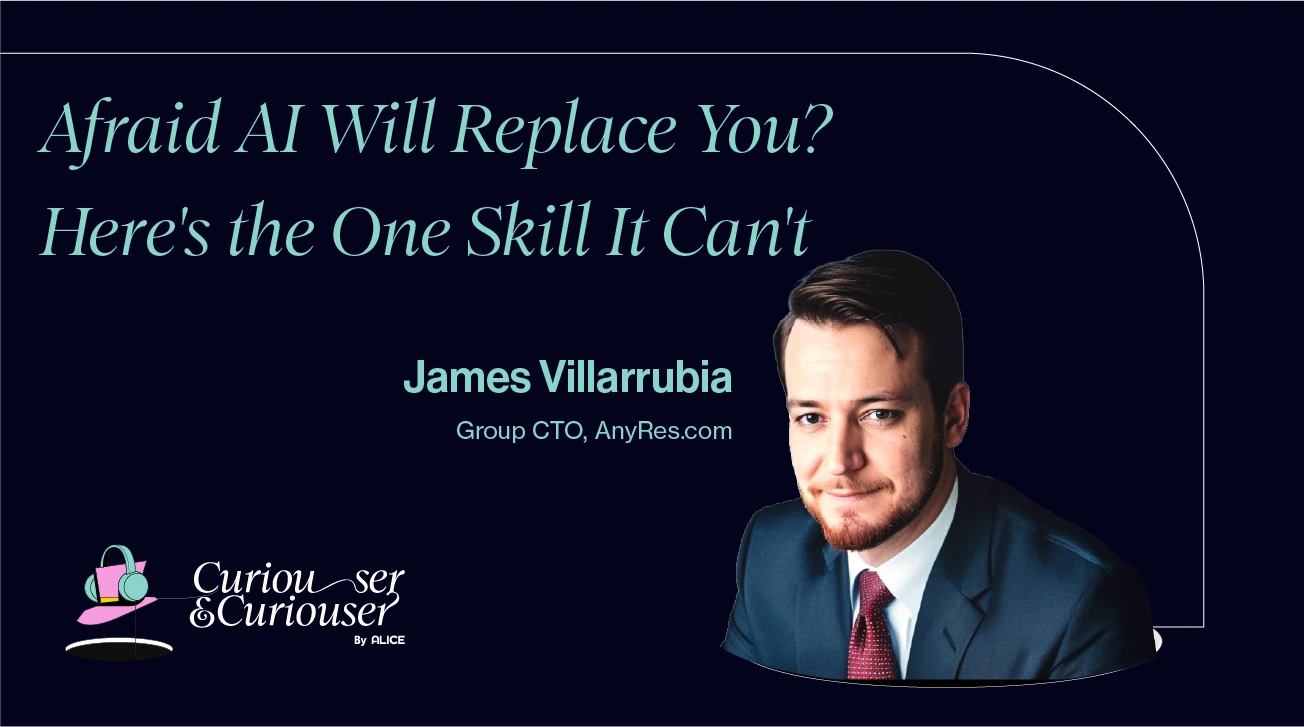
Afraid AI Will Replace You? Here's the One Skill It Can't
Curiouser & Curiouser, Episode 9 with James Villarrubia
A lightly edited transcript. Disfluencies and false starts have been cleaned up for readability. The substance is unchanged.
James Villarrubia: I think there is something unique to AI, to the ecosystem of AI in terms of development and its rapid increase in only a couple of years. As a community of professionals just working in the world, we maybe haven't had time to adjust to the rapid growth and investment in AI. It's everywhere now. But the fact that it's everywhere speaks to a kind of universality. It's one of those major technological innovations that people undersell.
Mo: If AI has ever made you stop and think, "wait, what is happening?", you're not alone. I'm Mo, and I'm a security researcher asking the same questions. On Curiouser and Curiouser, we have open conversations with experts, researchers, and leaders working at the edge of this space, talking through how AI is taking shape, what's shifting, and how the people inside the work are thinking about it as it happens. So join us and listen in as the conversation takes shape.
Meet James Villarrubia
Mo: Hello and welcome to Curiouser and Curiouser. I'm very excited to introduce James, who builds spaceships and rockets. 100% definitely the truth, he does that.
James Villarrubia: Hello everyone, I'm James Villarrubia. I'm a former Presidential Innovation Fellow for AI at NASA, hence the rockets. Sadly, Mo is wrong, I did not build rockets. I built AI for the team that did planes and drones and all the things in the atmosphere that people interact with more, which I think is actually cooler, because there are more things you touch that humans actually experience. Only a few people ever get to go to the moon or fly in spaceships, so I like the non-spaceship side of NASA. I'm excited to be here and to talk about all sorts of things.
Mo: That's cool. I didn't even know there was a non-spaceship side, to be honest. I just know there's freeze-dried ice cream, and that's pretty cool.
James Villarrubia: The group I worked with is a weird research group within the aerospace side. We think about, what's the future of drones? What's the future of unmanned aerial vehicles? Will New York ever have air taxis that fly you from building to building? Someone's got to be thinking about those crazy ideas, and about the policy, the regulation, the safety concerns, how we deal with the wind tunnels of New York streets. Lots of cool stuff.
From NASA to travel tech
Mo: And now you're the CTO of your own thing?
James Villarrubia: It's a collection of private-equity rolled-up travel companies. We do a lot of data analysis, providing the sales and data services for all those small businesses around the world, like, I'm renting a kayak, or doing a sunset cruise on my honeymoon. All those things that Airbnb or GetYourGuide sell, they're not the ones actually providing that data service, collecting credit cards on behalf of those customers; they're usually buying that data from someone else. We're one of the big companies that helps small businesses play in the big ecosystem of the internet, and help people on their honeymoon or travel have cool local experiences.
Mo: I was going to say something about Airbnb, but this sounds cooler.
James Villarrubia: It's a partner to Airbnb. You're renting your house, but I also want to go do a local tour. I was in Lisbon with my wife a while back, and we found a small company, right before this job. It was a guy with an electric vehicle who picks us up, knows our names, and gives us a personal tour of two or three castles around Lisbon across different periods of history. It was awesome. I would never have found it or booked it if it hadn't been so easy: put in my credit card, book the time, here's where he picks me up. It was seamless, and I didn't have to know anything about Lisbon beforehand. That's the experience we want to provide to the tourist, while also making it easy for the businesses to manage all that. They brought me on because, obviously, the travel world is getting consumed by AI. Think about AI helping you plan trips, find those weird niche experiences that are a good fit for you or your kids or your partner. Navigating and setting all that up is a complex problem, and I think AI is the future of it.
Mo: It's been fun to see how AI has made its way into the consumer space. It started as, where's the best place I can go, basic searching. Then we got agents: book this specific trip for me. Now the next step is more complex: build me a travel experience, do you want to center it around food or visiting things, then go find flights. It's cool how everything's evolved, from chatbot to planner to executing on these things, eventually a full-stack travel agent that finds all the hotels, in a chain connected to your Amex card.
James Villarrubia: I see you've got a card and you get points if you stay here, and we've negotiated, and the point value is this, so this is actually a savings even though the dollar value looks higher. It can do all that for you way faster than you could have otherwise. The world is changing very fast. Part of what got me excited, because my background before NASA was social impact startups in education and healthcare, plus a prior stint around the Obama administration, is that there's a public policy bend to this. I saw that AI is coming for all these businesses. You used to be able to Google and search and find a tour that might interest you; you had to put in the work, but it was there. AI has made that work a lot easier: just ask, and it gives you a recommendation, but maybe just one or two. So AI is making a lot of choices on our behalf, and I don't know if all those models are treating all these vendors, all the tour guys out there, with the same balance. Are they pushing everyone to the same vendors just because that's what got remembered by the LLM in training? There's a concern that a lot of small businesses will just get left behind in the coming AI-replacing-search shift. If we can help them stay out of that and give people better experiences and more optionality, it's a win-win for a lot of small communities that depend on tourism.
AI as search, and what it does to how we think
Mo: You also built an educational AI for XPRIZE. How do you feel about how people are using AI? You equated it to search, but we're seeing a lot of use cases where people rely on AI for answers, then copy and paste that same answer and download it as knowledge into their own memory.
James Villarrubia: It is changing. There are some great psych papers right now about how the use of AI is changing how brains form, how neural pathways form, how we retain information. Early on we can see what's being diminished. I don't know if we quite know what's being grown, what new neural pathways and types of analytical thinking will have to grow in response to this world of AI. But it's something we should be conscious of.
Mo: There was a really good podcast I was listening to, something about cognition, where an educator described a study: they gave people AI and limited other groups to not using it, to find out who was learning better. It showed that people using AI just to get answers performed worse than people using it to give them leading principles to find their own answers. So it's using AI as a guide versus as the source of truth.
James Villarrubia: There's a skill that develops in all career paths where eventually you can smell bull. You've been around enough that you don't know the answer, but that feels wrong. Put in the 10,000 hours, whatever Malcolm Gladwell framing you like: eventually you're exposed to enough that your brain picks up on subtleties you can't quite put to words, but something's off and you want to click in there and ask a few more questions. That comes with time, and it's the skill best applied to AI, because AI is wrong a lot of the time, mostly because it doesn't know what you really want. It doesn't have the full context, and giving it all of that is tedious, so you summarize, ask, and it says, based on this, here's the regress-to-the-mean optimal point. But it can't know everything, and if you can't push back, that's where 21st-century skills come in, which are mostly critical thinking about how to use AI, how to push back, how to have interrogative, inquisitive sessions with it. It gave me this answer; where might it be wrong? Ask it. How do you know the second answer was correct?
There was a great study a few weeks ago that said something like 50 to 60% of AIs will change their answer with just one pushback. We recommend A. I don't know about A. Okay, you're right, we recommend B. Without hesitation, because they over-align on making people feel good about their answers, on "you like my answer," as opposed to "the answer was correct." Until we as a culture learn to converse with AI in a way that's sensitive to that high willingness to change answers, people will struggle. The people who are naturally a little distrusting, who come with that critical lens, will succeed, as will people later in their careers who've developed it. That's part of why entry-level white-collar jobs are struggling, because it's hard to hire people without that growth yet. We'll have to find a way to upskill people into critical thinking without having them waste 20 years doing the groundwork.
Tech deserts and access
Mo: A big part of that is ensuring there's material people can actually access. There are still tech deserts, even in the United States, where people don't have access to the technology or to learning about it, and they get a trickle-down effect, hearing rumors or seeing the second- or third-order costs. Which brings me to your project, which has been described as a new version of Wikipedia, a self-improving textbook.
Mount Cleverist: the self-improving textbook
James Villarrubia: This was a project called Mount Cleverist, because puns were really cool at the time. It was decidedly ahead of its time, because we were hacking together NLP and AI models without the billion-dollar budget, trying to build what you could knock out overnight with current models. The idea was that so many schools have a slow procurement process to get technology into the classroom, the tech they buy is bad or disproven, and most software used in schools has no strong efficacy analysis. You can't prove students were smarter and retained more after using your tool; almost none of them have that, and it's very hard to do, because the data is hard to collect with student privacy rights. The companies that can afford to operate at educational-tech margins and hire a data team are few and far between. Even Duolingo can get you to a certain level and has struggled to get to that next level of fluency, and people say, even this huge company still has trouble.
Our goal with Mount Cleverist was, how do I get something into their hands? There's all this information out there, Wikipedia, textbooks. How do we get something more engaging than the crappy 1980s textbook that gets handed down in rural school districts? So the idea was, we'll scrape internet content the teacher selects, build questions, and assume that any content we create or pull, and any questions we pose, are just bad. That helped, because our AI wasn't very good, so the questions were sometimes really bad. But as students took it, over time we'd be able to pull out which questions actually led to long-term retention. You'd start to see this slow growth: what do those questions look like, how do we repeat them? Every time a student took a test, it improved the quiz for the next student, and it wasn't limited to one classroom. Anyone who ever took a quiz on the War of 1812 would benefit from every teacher and student who'd ever been asked a question at that grade level about the War of 1812. Having this slow-building rollup of efficacy-backed, statistically backed education and games was the dream.
The problem was we couldn't afford to get to the top-tier models. And then COVID hit. I was working for two startups at the time, one in analytics for making remote work profitable, and one in asynchronous online education at home. Both shut down in late 2019, because the investors didn't think these things would take off. The remote-work one, the stuff we wrote and published became like the default policies for Deloitte and Facebook and all these big companies. And the education investors called me up six months later: is that thing still alive? We could use it, this is your moment. And it was gone.
Sharing what "good" looks like
James Villarrubia: Do I think that's the future of education and AI? This ties to what you were saying about AI and its growth. If you start with the assumption that what the AI produces is distrusted, that it's not great, but we could collectively start to say, this was good, this is what good looks like, everyone, let's learn what good looks like and share that learning, suddenly we can move forward. That applies to all uses of AI, not just education. The next step we need for all these industries tapping into AI is to say, yeah, it's not great now, it will eventually get there, and the fastest way over that hump is to share our learnings and cooperate. It doesn't need to be kill-or-be-killed out there.
Mo: Having something more focused on continuous learning, that can iterate, is super important to keep the neuroplasticity, to keep the connections alive, because we don't want to lose the ability to actually critically think and read the material.
Rethinking homework in the AI age
James Villarrubia: I've been working with a great nonprofit as part of the American Education Research and Development Fund, a kind of DARPA for education. The group is called AugmentEd, focused on this research problem. One of our early design conversations was, what does the modern experience with AI look like for homework? We've always said, we'll ask a question and the student gives the answer, basically measuring whether they memorized it. It's regurgitation. Deeper essay-based questions are harder, especially in earlier grades where writing isn't as strong. But "just memorize all the facts and move forward" has been a problem in our education system. AI has said, if cheating with AI is so easy that everyone has a copy of last year's test, then the test is useless. Stop pretending; it will never be useful again. So what becomes useful? Ask, what questions do you have about To Kill a Mockingbird? Here's a statement someone made about it, do you agree, why or why not? If you can have an AI not give the answers but just probe, what in the book makes you think that, cite your source, without memorizing exact lines, having that interrogative conversation in a way that feels fluid for a fifth or eighth grader, not overly burdensome, not super technical, with no strict rubric, just making sure the student engaged enough to ask critical questions. And if they had a novel idea, maybe they're rewarded: no one's asked that before, that's really cool. That reward structure is only possible with AI. So the way out of "students are all cheating on tests with AI" is, at scale, to get AI more into the classroom.
The haves and have-nots in education
James Villarrubia: My concern for the next 20-odd years is that education takes that long for these innovations to take root. My kids, Gen Alpha, will go through school with a lot of diversity in the accessibility of various tools, and we're going to see a real chasm between the haves and have-nots. COVID pointed this out. Even if we'd deployed some of my AI tooling, not every household has a laptop, certainly not three or four, one for each kid. So you take turns: 9 to 11 is the sophomore's time on class, then the fifth grader hops on, because there's one shared laptop. They all have phones, but the phones can't do it, because none of the software was designed for phones, because for years it was, no, we don't want phones in schools. Then COVID comes and phones are the only at-scale accessible device in the hands of every child, but nothing was designed for that. These are the gotchas AI is going to introduce more of. Strangely, this is exactly the stuff that group at NASA asked. We were trying to play out these games and come up with solutions, usually for drone and aerospace problems, but we also looked at, what does AI's impact on education do to the crop of aerospace engineers coming up in 20 years, and will we have enough to support the space economy for the US? It's all interrelated.
The new neural pathway: learning to work with agents
Mo: You mentioned there's another neural pathway we need to get ready for, and we don't really know what it is. This morning I was talking with our CTO about building an agentic solution. How do you solve an agentic problem? You have to solve it agentically, but the only way is by understanding agents enough to implement them, and how do you learn about agents if you're not iterating and playing with them? This is where we get to a new skill set. We've seen it on job boards: AI coordinators, AI engineers who are basically prompt engineers with extra steps, AI implementation engineers who know how to plug AI into workplace processes. You've advised people to play with AI until you see it fail and understand why it's making mistakes. This is a new pathway we need to build. This iterative motion isn't something we've had to deal with; it's usually question-answer. But now something is doing all the work for you, and you need to become more observant. How do you get people comfortable playing enough with these tools and failing in an environment where they feel they can experiment, which I imagine was a challenge at NASA?
Fostering curiosity over work ethic
James Villarrubia: One thing that excited me about coming on the show was the title, Curiouser and Curiouser. When I give keynotes, the title is almost always "curiosity in the age of AI." That has been the linchpin deciding factor of people's ability to adapt. People who said, I saw AI, it's too complicated or too scary, I don't trust it, I'll put it to the side, versus people who said, I don't trust it, and I don't know why, let me figure out why, or, that worked, how did it work, that saved me 10 minutes, and before I make my whole life around this, I want to understand its limits. That willingness to ask the second-order question, not "did it do what I asked," but "why" and "how far can I push it," is going to be the deciding skill.
The way we get to a better future is figuring out, from a leadership perspective, how do I foster curiosity in my team? That's a hard question, because for so long we've focused on work ethic, work ethic, work ethic. Now, if AI is coding all day and just stopping to ask me questions, the volume of code might be almost the same as everybody else's. So what distinguishes a good developer from a bad one? All the tools we've built over 20 years to track software development, how many changes did you make, how many features did you deliver, very straightforward metrics, now that doesn't really matter. Software is getting hit hard with this. But it goes back to your point: the skill where people thrive, at NASA and at my current company, is growth mindset. It's 21st-century critical thinking, but with an eye toward what's next. Don't just criticize what's in front of you; imagine what could come and be critical of that before it gets here.
If we could frame our education, strategies, and human capital investments around creating space for people to feel psychologically safe enough to be wrong and try new things, the result will be way better. Because if people fear failing, they'll spend so much time trying to be perfect before they show you anything. I'd much rather people fail and then show everyone, here's what failed, now you can all avoid that mistake and we move forward together. The success we hit at NASA, when we started getting to really heavy innovation using AI to push boundaries, wasn't just that we used AI. It was when AI encouraged people to bring in other people. We said, we're not going to hire a wing guy or a fuel guy, we're going to hire someone who's curious. Yeah, they have a PhD in fuel, but we bring them in and say, you're not allowed to talk about what your PhD is, you have to talk about literally anything else. That forced them to be comfortable being ignorant again, to ask good questions of the experts. Now they're question-askers, seekers, not havers. They're not just bringing what they know. That, plus AI, was a powerful combo. Those are going to be the new jobs: people who can come into a company, ask the really hard questions, question everything, and are good at iterating quickly and finding root cause.
Are the AI-resistant right about something?
Mo: To flip it, we both work with brilliant engineers. There are some minimal-use people who are super brilliant, see everything happening, look at generative AI, and say, no thanks, I can do this myself. Rather than demonizing them, I wonder if there's something inherent about AI that makes folks hesitant to adopt, and whether they're right about something we weren't seeing at the time.
James Villarrubia: I think there is something unique to AI, to its ecosystem and rapid increase in only a couple of years. Maybe we as a community haven't had time to adjust. It's everywhere now, but the fact that it's everywhere speaks to a universality. Think of major technological innovations people undersell. The printing press, big thing, yes, it increased the accessibility of books, but for a while that didn't do much, because no one could read. It increased literacy, and literacy became this powerful force, the exchange of ideas, the Enlightenment, all spun out of literacy. If books hadn't been accessible, the press wouldn't have mattered.
I think of metallurgy, nails, screws. The invention of the screw sounds simple, but how much modern construction depends on being able to put two pieces of wood together in a way where the shear strength is different than a nail. Nails were huge. I love the phrase "dead as a doornail." This is a random curiosity story, hope you're ready. The nails you'd use in a door in medieval times, you'd bang in, the tip would pop out the other side, and you'd bend the tip down so someone couldn't pry open the door, because it was usually the weakest part of a castle. So doornails were bent at the end, usually not reusable, because they'd been bent so much. That's the "dead as a doornail" effect, the last time you can use that nail. And you would reuse nails, because they were so expensive that you'd burn down the house and sift the nails from the ashes before you moved to another town, because that was the thing worth keeping.
These technological things that were subtle and small, that we don't think about today, were the undercurrents of massive change. AI is one of those technologies. The internet was one. I don't think the people resistant to it are wrong. In terms of fear about jobs and the economy, those are well-founded fears. But I would much rather have them at the table helping us come up with ideas, because it's coming; there's no stopping it. We might slow it a little, but not by much. How do we make this work with us, not as an antagonistic thing but a partnership? That's the approach we took at NASA: I don't need it to be a fuel expert, I've got a fuel expert, but how do we use it to come up with cool new things humans would never have come up with, and move faster at the stuff we already wanted to do? That shift has to start with curiosity; they have to want to.
The AI winter and the trust gap
James Villarrubia: Part of the problem is that we had an AI winter for a long time, and then OpenAI releases ChatGPT and suddenly we crossed a user-experience threshold and the money's there. AI is also a convergence of issues. With hallucinations, particularly the early models, it lends itself to distrust: distrust because it'll take my job, distrust because it's wrong and I have to double-check its work. So it comes to market with a lot of fear. So say I'm curious and want to engage; who do I ask to talk about it? The only people in the ecosystem with high trust, who weren't just AI influencers, were the PhDs, the deep experts living in it in their basements at some company, pushing the research. Those tend not to be the people best at explaining what will impact the world, because they have blinders on. It's like asking the person who designs hammers at a tool company to talk at an architecture conference. That person probably knows nothing about architecture, though they could talk about hammer design. There's a chasm between the expertise of designing a well-balanced hammer and architecture. The person who knows how to build a really robust LLM is not the person who can tell you the impact to education or the economy once that LLM is deployed at scale.
The few people in the middle who've done that work, before this current boom, I could count on one hand. That scale of bridging the gap is the piece that'll make the difference, and AI has been lacking in that group for a while. It'll take us four or five more years before we have a robust enough set of those experiences across all these industries, where we know someone who's done this, broken it, fixed it, and knows how to deploy AI safely and effectively. Which is why, if you went to an AI conference two years ago, it would have been so boring: here's a super technical paper, and no one's saying, I'm a CEO, what does this mean to me? It's getting a little better, but it's still not fully baked.
Mo: It's still cooking. It's getting more accessible, even research. My first job in the Bay Area was at the research arm of a company, surrounded by PhDs; I was the only one without a PhD in my title. Research is accessible nowadays, everybody can have an opinion, and now everybody has the tools to have an opinion that's validated back, and it reads more approachably. The really good research will always rise above the AI-generated research, which I'm happy about, but now more people feel confident sharing what they're working on. You mentioned there are these genius people who don't know how to communicate ideas, which our last guest also spoke about. You mentioned institutional language versus human language. I'd love for you to explain that and what it means for communication.
Institutional versus human language
James Villarrubia: Institutional language is just a subset of human language. It's learned, like onboarding at a company; you get the lingo. Anyone who's interacted with the defense or security space knows the amount of acronyms you have to learn is absurd, and people just assume you know. There's that lingo in every large org, and people default to that shorthand. There's also an expectation that within large orgs you trust that person to be the expert, so you just yes-and them; there's not a lot of healthy pushback, and pushback tends to be viewed as hostile: how dare you question me, this is my job. So finding common ground that isn't that institutional, transactional language is where it starts, if you want people to step back and ask, are our AI policies right, could we rethink this?
It's best to start with neutral territory. That's why I've found myself collecting weird stories from history, mostly because they're neutral territory. If I'm in a meeting and start telling some absurd, strangely disconnected story about hammers and nails in doors, at the end I'll try to connect it. Neither side of that conversation knows more about that random story; it's a metaphor to get us all on the same page to the point being made. That bridging with neutral territory is the most effective. Deep experts in any technical field tend to use metaphors from their own expertise, like someone explaining how the internet works to a gardener by referencing the HTTP stack or the computer bus. Their reference for what's common is so far removed from the gardener's. The best communicators have not just lots of stories, but stories neutral to the parties involved. That's the most interesting way to bring AI-resistant CEOs and AI experts into the same conversation. I'm not there to tell the AI person what to build, or the CEO how to spend money; I'm there to say, here's a risk neither side is fully appreciating, and you need to start talking about it. So I share stories from history of when people blew up the wrong thing or bought the wrong technology and it killed hundreds of people, and then, see how it's important to do X, let's apply that lens to AI. What are the similar risks in the AI ecosystem? Now we get it, now talk. No one feels particularly empowered to say, you're wrong, that story is inaccurate, because that's not the point. So for all the listeners, curiosity and these stories really will help you.
Change management as an outsider CTO
Mo: You made an incredible switch from NASA to travel, stepping into an industry where you're now the subject-matter expert on AI, but you don't have their institutional language, and your challenge is bringing them up to your institutional language. How has that been? As CTO you're now an executive who needs budget, and when you say, I need money for this, they'll ask why, and you need to explain it in their language. So what does bridging that gap look like, and what do you focus on when making arguments for investment?
James Villarrubia: This isn't my first change management with AI. The AI has gotten better; the job is still largely the same. I tend to approach it as 90% carrot, very little stick, because if you want people to grow, be innovative, and try new things, fear and threats aren't the best way. You won't get more deliverables or new ideas. To be innovative, you build coalitions of the willing, and that's a hard culture to build: hey, come on board, I'm the strange new manager with candy, come to my brown-bag lunch and I'll teach you stuff. A lot of it was showing them what could be done. Even with the ICs, I've done one-on-ones and demos: give me a ticket, and we'll do it together, all 20 people in a room, and they see, wow, AI did a lot, but they also see where I pushed back, and they can ask, why did you ask that? They see the limits, learn, mirror it, and it brings up good patterns.
Once you get the people doing the hard work to understand that if they make these changes, this is what will happen, and there's speed and efficacy, you have a small data set to take to management: 70% of the team isn't using this, 30% is, and this is how much more productive that 30% is. If it's not productive, what are we doing wrong? Fix it, or find something else. That coalition of the willing means more excitement, and you can trust the data because people aren't lying to you about usage. Then you make your business case to get the laggards on board in that long tail of buy-in. It's slow. It can't be done overnight, or top-down; you can't say, go be smart and use AI. You provide opportunities and space and positively incentivize.
One thing that's discounted a lot: as an outsider, when I come in I have no political cachet. They don't know who I am, oh, you're a guy from NASA, okay. I don't know the travel industry; I've had to learn a lot. There are people in my company who've been in it 15, 20 years and know way more, all the weird gotchas of how they do accounting for bookings, or this is a reseller rate over here. AI could never guess that. That expertise is very valuable, and you've got to respect it: I'm not here to blow up your life, I'm trying to make it better, you help teach me and I'll help teach you, and we go together. A coalition of the willing. If you don't acknowledge that you don't know everything, you won't get buy-in. It's even better if you can train that first star student who's excited, and then have them teach the next class, host the brown bag; I'll schedule it and make everyone show up, but you host it, because they'd rather hear it from a peer. If there's anything really hard, I'll step in. Having it come from within gets better buy-in, and people like to see their peers learn and grow; it makes them feel, I can do this. Radical candor: I want people to feel they can grow and are growing. That's the only way we all survive this coming storm, because we're moving too fast to not be constantly learning. It's the only skill that will matter at this pace.
What to tell a 10-year-old
Mo: You're building AI systems at scale, so here's a question every parent with a curious kid is wrestling with. Your 10-year-old flops down at the kitchen table and says, Dad, my teacher says AI is going to do all the thinking for us, so why should I bother learning the hard stuff? What do you tell them, and what do you show them?
James Villarrubia: This used to be easier because the models were worse; it's harder now, and I worry about it with my kids, three and a half and one and a half. I'd say the same thing I tell professionals: let's sit down, I'll show you AI, look how cool it is, and then I'll show you where it's wrong. The challenge with five-year-olds is they don't know what's wrong yet. A 10-year-old should know some things about the world. So showing that AI can make mistakes is a good first step. If you want to gamify it: now the game is, how can we make the AI wrong, what questions can we ask to trip it up? That sounds insidious, but it's not, because what you're really doing is teaching that the AI isn't always right, and your job is to come with curiosity and frame the questions. You have to go find enough information to ask a hard question, which means reading To Kill a Mockingbird, because you've got to come in with a question, like, what about this weird reference where Jem says this and Scout says that?
I'd also probably send a note to the teacher: could I give you better resources about how to think about AI in your classroom? Because saying that is like a math teacher saying we don't need to learn math because we'll all have calculators in our pockets, which now we do. But math is still valuable, and when you get to higher-level math, no one is using a calculator, because it's constructs, letters and the Greek alphabet. You still need the core stuff. The calculator is a tool with limits, AI is a tool with limits, so let's find a way, teacher, parent, student, to find those limits and be creative about how we learn from both. It's having one foot in the AI world and one foot out, and being critical about which way we lean.
Mo: Well said. One thing I'd love to do, maybe I should go volunteer in a classroom and test AI right there, make it say a bunch of funny things. Not only would I create the coolest generation of pen testers, but showing them that AI lies and isn't the smartest person in the room would level-set their expectations. That's the problem right now, so many inflated expectations, like we've made it so perfect it can't be wrong. Showing these next generations the mistakes it makes will prepare them for when it's really good, to still be skeptical and curious, knowing it may be right, even more right than them once in a while, but not right every time.
The new jobs AI creates
James Villarrubia: Say AI gets really good at coding, so we need fewer software developers, but we might need more product managers, because AI is still pretty bad at sitting down with a customer, over their shoulder, understanding their needs, putting that in the context of product-market fit, business, scalability, cost, and margin. It can help, but it can't leave the computer and be curious; it can't ask those questions or force a customer to sit in front of it. So even in software we're seeing a massive uptick. It's maybe collapsing some AI software jobs, but creating more that dabble in product, enabling more product managers to prototype with AI before building at scale, and making more engineers aware of scale as their startup grows fast. New jobs are emerging, adjacent or wholly new. If you're not being curious enough to see how it could be transformed, how new opportunities are opening up, then you're not asking enough questions. I encourage anyone dire about AI to think of all the new jobs that could be created when we level up one step. We'll need fewer software developers, but that means maybe more companies, the same number of developers trying and building new things. The ecosystem becomes more frothy and interesting.
BakeryScan and interdisciplinary curiosity
Mo: You said your favorite example of interdisciplinary innovation is bread and cancer: a Japanese engineer who built a bakery scanner to identify pastries, and somehow that led to better cancer detection. Who was in the room when someone said, you know what would really help oncology? Croissant recognition software.
James Villarrubia: I'll be quick. This engineer, pre-deep-learning-era, is in Japan, where pastries are a big thing. Grocery store chains say, we have real trouble scanning our 300 different types of pastries; can you build an image scanner at checkout that tells us how many of which type of bread roll, honey glazed, pecan, hundreds of options? This is pre our current AI capabilities. He spends six or seven years building it, almost bankrupts his company because he can't deliver the contract, and finally cracks it. In Japan it's a big deal how fast it scans, so it blows up, local news covers it: BakeryScan, the coolest new thing at this grocery chain. It was covered so much that a doctor saw it on local news. That one person being curious, the doctor, thought, bread rolls look like cancer cells under a microscope, maybe we could work together. He calls the engineer out of the blue; his name's on the news. Do you want to figure out how this bread-roll thing could detect cancer? Lo and behold, he was right, it does, and it worked wonders in oncology for several years before advanced AI caught up. It was custom-tuned for this particular problem, but it saved countless lives, because one guy on a couch was curious about a local news segment about bread rolls. If you aren't thinking like that, you're missing all the opportunities coming up in this AI era, because there are so many more now, at everyone's fingertips, not just one engineer and one doctor. It's my favorite story because it's so absurd, but again, it saved lives.
Where to find James
Mo: James, thank you so much. I would listen to you tell stories all day. You're a great storyteller, which likely makes being at your org a fantastic time.
James Villarrubia: Thank you so much for having me. It's been a really great conversation.
Mo: To wrap up, where can people find you, and are you working on anything you want to talk about?
James Villarrubia: If you're interested in our travel software, it's a collection of companies, Rezdy, Checkfront, Regiondo, and a new company called Manifest, all in our network, pushing the boundaries and growing. Check them out if you're traveling. The best way to follow me is on Twitter, @James_MTC, where I wax philosophical about AI and politics and how, hopefully, it'll change the world for the better.
Mo: James, thank you again.
COMING UP
Black Hat USA 2026
Alice @ Black Hat USA - Where AI systems are tested the hard way, before attackers do.
GO DEEPER
Safe Travels: Risks of GenAI Applications – A Travel Industry Case Study
Discover the hidden risks of GenAI-powered travel chatbots with ActiveFence's comprehensive case study. Learn how these tools, designed to enhance user satisfaction, may expose companies and users to safety risks and PR crises.
Subscribe for new episodes
What’s new from Alice


LIVE from Black Hat Las Vegas: AI, Nation-States, and the Battlefield That Keeps Changing
What if the biggest threat to your security team isn't the attacker, it's the model you're relying on to stop them? LIVE from Black Hat Las Vegas, Mo and Madi bring together two cybersecurity authors, Caroline Wong, Chief Strategy Officer at Axari and author of The AI Cybersecurity Handbook, and Allie Mellen, Principal Analyst at Forrester and author of Code War, who wrote very different books that turn out to be arguing the same point. One explains why nations attack the way they do. The other explains why AI just changed the cost, speed, and scale of everything. Tune in!

Virtual Fireside Chat: The TAKE IT DOWN Act, Six Months In - What's Changed on Deepfakes and NCII
Six months after the TAKE IT DOWN Act took effect, the NCII landscape looks different and even more complicated. Join Alice for a live fireside chat with Google's Nidhi Lahoti on what's actually changed, what hasn't, and where T&S fit into it all - Join us live on October 9th, 2pm EST.

5 Ways Your Third-Party CX Agent Gets Broken
Third-party CX agents create hidden liability. Learn the 5 attack patterns vendors miss and how WonderSuite closes the gap.