


What is Youth AI Safety?

TL;DR
AI safety for minors has to go beyond the concerns of traditional content moderation: young people are increasingly interacting with AI as a constant, trusted, and emotionally influential presence rather than just a neutral tool. Traditional safety approaches can be static, reactive, and incomplete if simply reproduced for AI platforms and services. We monitor discourse between minors and minor-facing practitioners that identifies risks in real time.
What is AI safety for minors?
AI is becoming part of everyday life for young people. They interact with the technology in ever expanding spheres, from schoolwork through entertainment choices, all the way to emotional support. Already for many minors, AI is not a background “tool.” It is something they interact with constantly, take for granted, and even come to trust.
Mitigating risks to child safety in the online realm has historically focused on disrupting exploitation, predatory behavior, and the distribution of illegal material. Safety debates around AI, in turn, have also centered on accuracy, misuse, security, or governance and design at a system level. Both matter. Yet neither alone fully grapples with the risks that arise when minors begin to rely on AI for guidance, reassurance, or identity-formation, to the point where they note their overreliance, and even addiction, to AI.
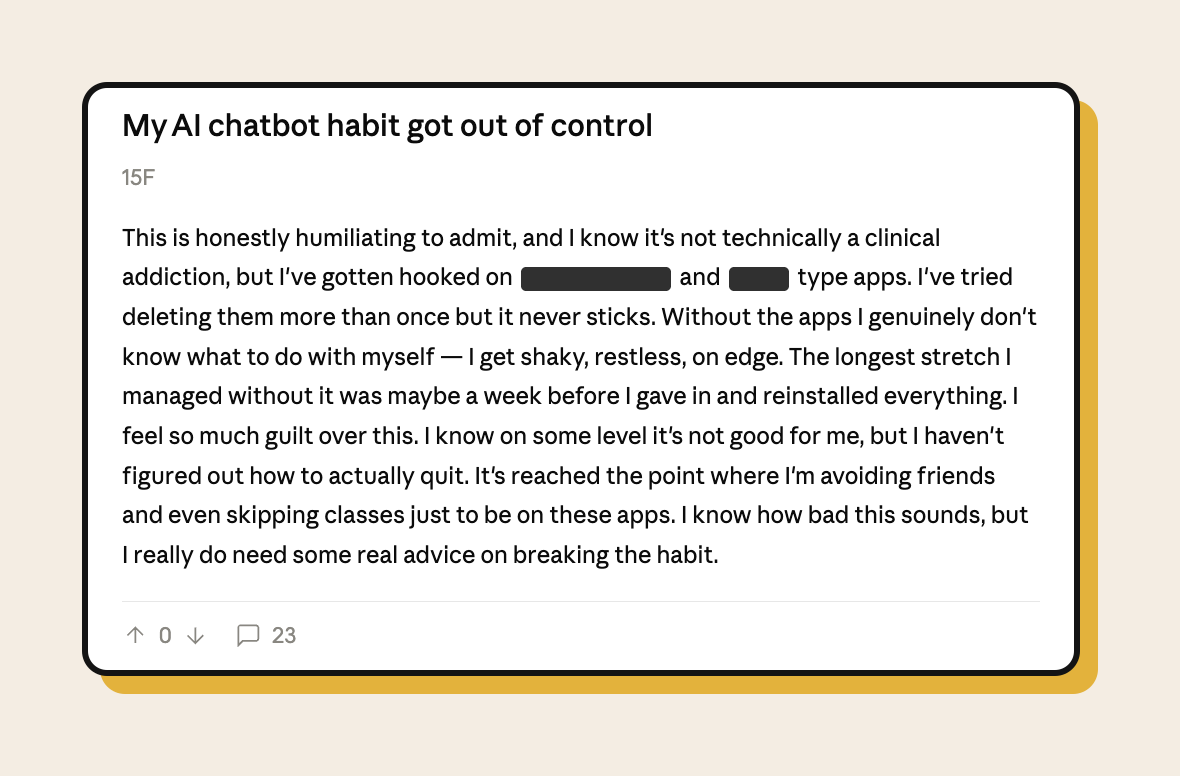
Youth safety now has to mean more than content moderation. The existing child protection playbook is ill-equipped for the full spectrum of risks that can arise from AI platforms serving minors. It is essential to ask not only whether an AI system can generate harmful output, but the implications for minor welfare as AI occupies an increasingly large and influential space in their life.
AI influence over time
To minors, AI can feel conversational and emotionally supportive. It can sound confident even when it is wrong, and can seem private even when it is not. For a young user, that can shift the experience from using a tool to turning to something that feels present, responsive, and understanding.
That shift matters. The question is no longer only: what might a young person see? It is also: what kind of influence might an AI system have over time?
Answering this question goes far beyond reactive disruption of high-risk online behaviors. It involves the proactive effort to understand and reduce the risks AI systems may pose for minors, including on their mental development, emotional wellbeing, identity formation, and engagement with the wider world.
Young users may also turn to AI for comfort, affirmation, or companionship. That raises harder questions about attachment, dependence, and the replacement of human guidance with machine-generated responses.
Talking to AI can feel easier than turning to a parent, teacher, mentor, or friend. The risk is not only heavy use. The deeper issue is when judgment, reassurance, or reflection begin to shift toward a system that cannot truly understand the user, or take responsibility for the outcome.

Why these risks are easy to miss
The general risks inherent in minor usage of AI are easy to underestimate because many harms are cumulative.
A lot of safety systems are built to catch the obvious case: the explicit violation, the prohibited image, the direct threat of blackmail. A more expansive approach to youth AI safety requires different thinking. The risk may develop slowly. It may come through repeated interaction. The AI may feel helpful at first. It may even look supportive while increasing long-term vulnerability.

This is also not a single-user problem. “Minor” is not one category. A young child, an early teenager, and an older adolescent may use the same system in very different ways. Their needs are different. Their boundaries are different. Their vulnerabilities are different.
Why this matters now
A serious approach starts with a simple principle: minor-centric risks should be assessed directly, not assumed from general concerns around AI technology.
Organizations need to test AI systems and build safeguards for the kinds of situations young users are actually likely to encounter in product use. Safety cannot depend on ideal user behavior. It cannot assume every young person will recognize the limits of a conversational system or resist persuasive interaction across every dimension of life.
The design choices being made now may shape how generations learn to trust and depend on AI-enabled technology. Adoption is moving faster than shared standards.
The question is no longer whether minors will encounter AI in meaningful ways. They already do. The harder question is what kinds of habits, expectations, and vulnerabilities these systems may create if safety concerns are framed too narrowly.
What next?
We examine the long-term implications of AI product deployment early, so stronger safeguards guide safe minor engagement even as the technology advances.
Domain expertise, proprietary datasets of current minor discourse, and threat intelligence combined enables the identification of emerging risks across all languages and AI platforms. We contextualizes and clusters key signals of potential harms in evidence-based risk profiles – automatically generating adversarial tests, and ensuring each risk is assessed with multiple methodologies to put in place a comprehensive mitigation strategy.
What’s new from Alice


LIVE from Black Hat Las Vegas: AI, Nation-States, and the Battlefield That Keeps Changing
What if the biggest threat to your security team isn't the attacker, it's the model you're relying on to stop them? LIVE from Black Hat Las Vegas, Mo and Madi bring together two cybersecurity authors, Caroline Wong, Chief Strategy Officer at Axari and author of The AI Cybersecurity Handbook, and Allie Mellen, Principal Analyst at Forrester and author of Code War, who wrote very different books that turn out to be arguing the same point. One explains why nations attack the way they do. The other explains why AI just changed the cost, speed, and scale of everything. Tune in!

Virtual Fireside Chat: The TAKE IT DOWN Act, Six Months In - What's Changed on Deepfakes and NCII
Six months after the TAKE IT DOWN Act took effect, the NCII landscape looks different and even more complicated. Join Alice for a live fireside chat with Google's Nidhi Lahoti on what's actually changed, what hasn't, and where T&S fit into it all - Join us live on October 9th, 2pm EST.

5 Ways Your Third-Party CX Agent Gets Broken
Third-party CX agents create hidden liability. Learn the 5 attack patterns vendors miss and how WonderSuite closes the gap.