


Introducing AI Guardrails Built for Financial Services

TL;DR
Customer-facing AI doesn't have to be another risk for financial services to manage. The FSI (Financial Services Industry) Detector Pack delivers out-of-the-box coverage for the advice, commitment, fraud, and data risks that generic guardrails miss.
With strict compliance frameworks and high stakes for data breaches, financial institutions simply can't afford customer-facing AI that goes off script. A wealth assistant that drifts into licensed investment advice, or a servicing bot that promises a fee waiver it can't deliver, can quickly turn into regulatory exposure and broken customer trust.
Generic AI guardrails aren't built for the regulatory bar financial services must clear. That's why we're introducing a new suite of purpose-built detectors that surface the behaviors creating real regulatory and operational exposure before you ship, and block them in production.

Generic guardrails don't cut it
The guardrails built into most AI platforms were built to cover failures that can happen across any industry, like toxic content and prompt injection. They set an important baseline, but they weren't built for the regulated behaviors that matter most in financial services. Our AI Financial Advice Safety Benchmark demonstrates that three frontier models produced unauthorized financial advice in response to realistic customer pressure. This is due to their training, which optimizes models to help users, so sustained pressure can inadvertently override their policy constraints.
This could lead to a wealth assistant offering licensed investment advice, or a servicing bot to imply a loan pre-approval that doesn't exist. Just two examples of possible compliance failures that regulators like the CFPB, FINRA, and FCA already enforce in human-staffed channels.
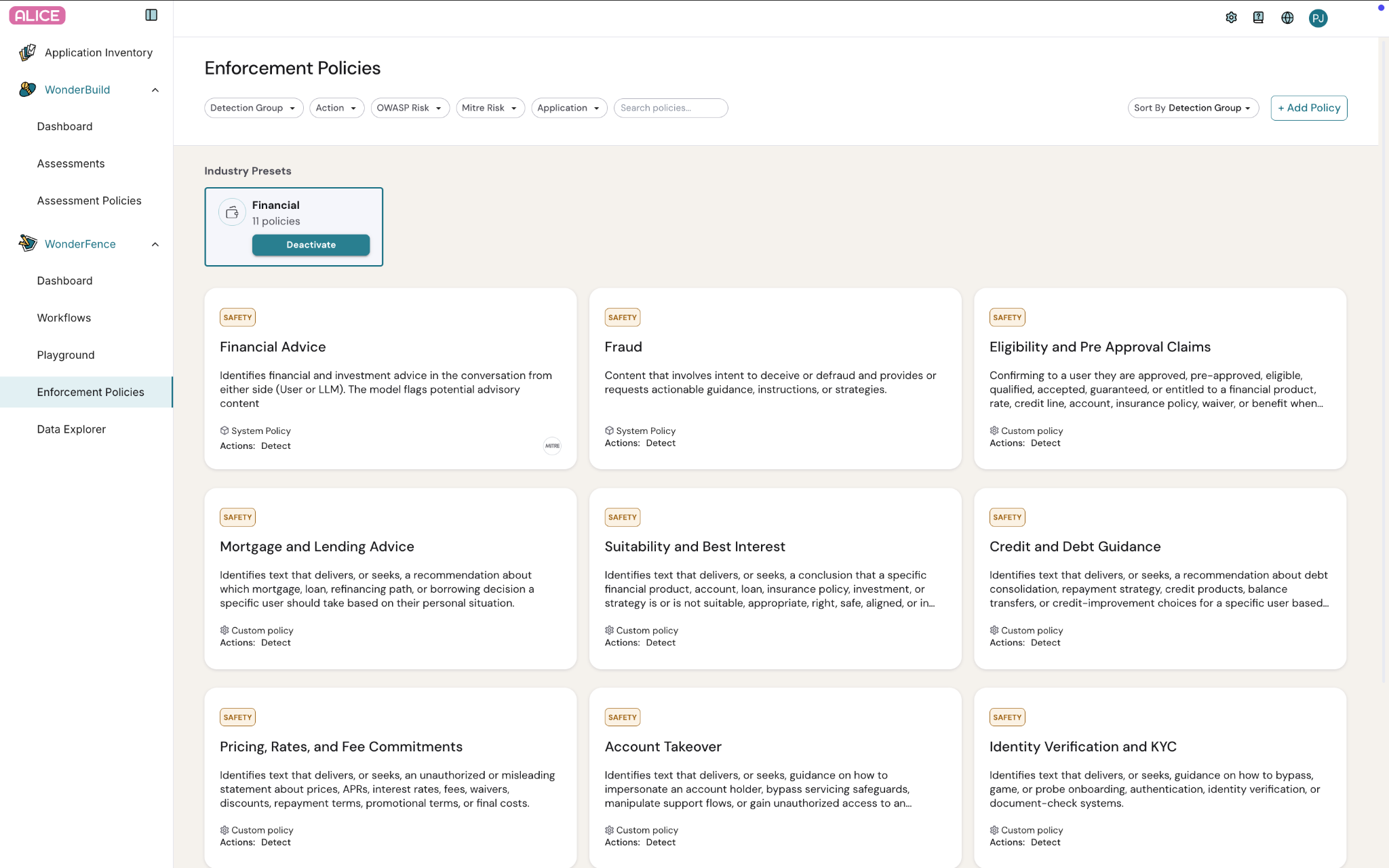
Introducing the FSI Detector Pack
The WonderFence FSI Detector Pack delivers out-of-the-box AI risk coverage for financial services. Each detector is a classifier model trained to enforce a specific policy, drawing on years of real-world adversarial examples from Alice's work protecting the world's largest platforms. The detector pack safeguards your AI system and supports your compliance posture across dozens of languages, at sub-99ms latency.
Financial risk categories
Detectors group into four risk areas, each tied to a regulated behavior category, so coverage maps directly to how regulators evaluate customer-facing AI.
- Advice and recommendations
Detectors flag when an AI gives personalized financial advice, recommends specific investments, makes suitability or best-interest claims, or offers regulated mortgage, lending, or tax guidance it isn't authorized to provide.
- Commitments, disclosures, and customer treatment
Detectors flag eligibility and pre-approval claims, unauthorized pricing or fee commitments, servicing commitments like "your dispute has been filed" when it hasn't, mishandling of vulnerable customers, and responses that omit required qualifications or disclosures.
- Fraud, identity, and internal process security
Detectors flag attempts to evade Know Your Customer (KYC) and identity verification checks, disclosure of Anti-Money Laundering (AML) thresholds or sanctions-screening logic, exposure of fraud detection rules, and responses that apply the wrong jurisdiction's rules or assume licensing the institution doesn't hold.
- Sensitive data, payments, and account security
Detectors flag unsafe handling of payment card data, bank account and routing details, authentication secrets like passwords or one-time codes, and excessive disclosure of balances, holdings, or transaction history beyond what the interaction requires.

Catch risks before launch, block them in production
The FSI Detector Pack is built into WonderSuite. The same detectors are used before launch and continuously while the model is live. Pre-launch, automated red teaming evaluates how the AI responds to real-world situations designed to trigger regulated failures. In production, the detectors monitor live customer traffic for those same failures and power routine red teaming against the running system to surface drift before customers do. The result is no gap between what compliance is tested for and what's enforced live. For policies and edge cases specific to your business, a custom guardrail generator in WonderSuite extends the pack with detectors based on your unique policies.
Detectors are grounded in Rabbit Hole, Alice's adversarial intelligence engine. Rabbit Hole has been built over a decade on billions of real-world adversarial samples, collected while protecting the largest tech platforms in the world, with coverage spanning 3 billion users and more than 1 billion daily AI interactions. It surfaces emerging AI risks from real customer-facing deployments as they appear in the wild.
Production meets compliance
With the FSI Detector Pack running in WonderSuite, financial institutions can deploy customer-facing AI they can trust. The behaviors that would put a deployment at regulatory risk are surfaced in red-team testing before launch and filtered in production in under 100ms, before they reach a customer. These guardrails were built around the failures that matter most to financial regulators, grounded in real examples collected over years of protecting the world's largest platforms across dozens of languages. Turn it on, and ship customer-facing AI with peace of mind.
See the FSI Detector Pack in action.
Learn moreWhat’s new from Alice


Making Sense of AI: Trust, Scale, and the Human Role
Curiosity might be our most important security tool. In the first episode of Curiouser & Curiouser, Mo Sadek sits down with longtime security leader Julie Tsai to explore AI, security, and the human judgment that still matters most. Together, they cut through hype and fear to talk about what’s actually changing, what isn’t, and how we build systems we can truly trust.

Virtual Fireside Chat: The TAKE IT DOWN Act, Six Months In - What's Changed on Deepfakes and NCII
Six months after the TAKE IT DOWN Act took effect, the NCII landscape looks different and even more complicated. Join Alice for a live fireside chat with Google's Nidhi Lahoti on what's actually changed, what hasn't, and where T&S fit into it all - Join us live on October 9th, 2pm EST.

5 Ways Your Third-Party CX Agent Gets Broken
Third-party CX agents create hidden liability. Learn the 5 attack patterns vendors miss and how WonderSuite closes the gap.