Listen on Your Favorite App
Episode description
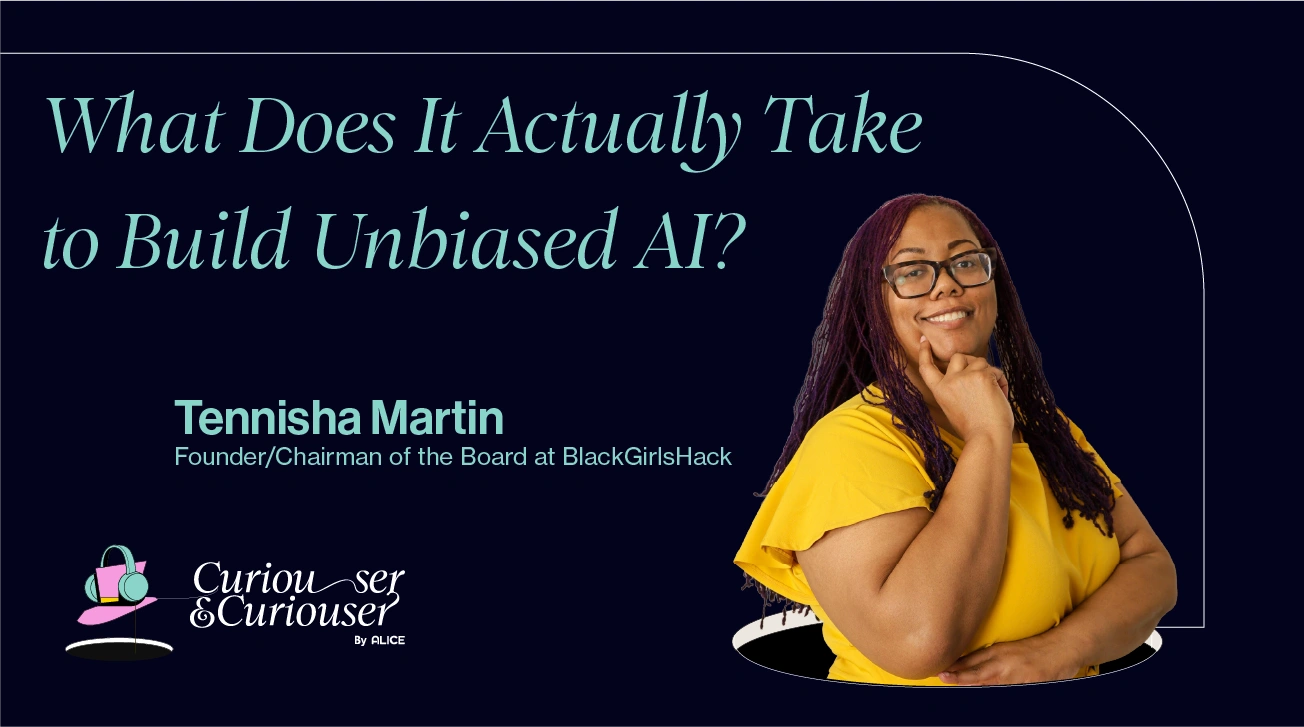
Nobody told Tennisha Martin the importance of having a mentor, so she built a community of tens of thousands instead. As the Founder and Chairwoman of BlackGirlsHack, her whole mission has been making sure nobody else has to figure it out alone. In this episode, she and Mo get into AI bias, why it's already showing up in places that matter far beyond tech, and why the real fix starts with getting the right people in the room when these systems get built.
Meet the guest

Tennisha Martin
Tennisha Martin is the Founder and Chairwoman of BlackGirlsHack, an international nonprofit that has helped tens of thousands of people break into cybersecurity and IT. A penetration tester, bestselling author, and doctoral candidate in AI and cybersecurity, she has raised over $1.5 million in funding, been recognized as the 2025 Cybersecurity Woman Hacker of the Year, and founded SquadCon, the only Black-led independent cybersecurity conference in Las Vegas during Hacker Summer Camp.
Full transcript
What Does It Actually Take to Build Unbiased AI?
Curiouser & Curiouser, Episode 7 with Tennisha Martin
A lightly edited transcript. Disfluencies and false starts have been cleaned up for readability. The substance is unchanged.
Tennisha Martin: We need people to research in artificial intelligence and machine learning. We need people to not think these are high, niche fields that aren't going to be around, because machine learning has been around for decades. Even though ChatGPT just got here over the last however many years, machine learning has been around for ages, and it's still a very lucrative field. But a lot of times you don't hear people saying, hey kids, go get into machine learning, go get into data science. So it's important that we focus on the next generation of ethical hackers and let them know there are career options out there for them.
Mo: If AI has ever made you stop and think, "wait, what is happening?", you're not alone. I'm Mo, and I'm a security researcher asking the same questions. On Curiouser and Curiouser, we have open conversations with experts, researchers, and leaders working at the edge of this space, talking through how AI is taking shape, what's shifting, and how the people inside the work are thinking about it as it happens. So join us and listen in as the conversation takes shape.
Meet Tennisha Martin
Mo: I'm super excited to introduce Tennisha Martin, founder and chairwoman of the board for BlackGirlsHack. It's a very cool organization, which I'll let her talk about, among the other 15 years of experiences she's had and her immense amount of degrees and education. Thank you for joining us, Tennisha.
Tennisha Martin: Awesome, I'm excited to be here.
Mo: Tell us a little about what you do, in more words than I just gave.
Tennisha Martin: My name is Tennisha Martin. I'm the founder and chairman of the board for BlackGirlsHack, the BGH Foundation, a nonprofit training organization set up to help underrepresented communities get into the cyber and IT fields. We try to reduce the barriers to entry, to remove some of the challenges for people trying to get into cybersecurity and IT. The organization is called BlackGirlsHack, but it's open to everybody, regardless of race or gender. We've helped tens of thousands of people get into IT and cybersecurity and build brighter careers. I'm also a director of a Fortune company, the CEO of my own company, a bestselling author, and I've been in the workforce for 20-something years. I consider myself a mentor, a penetration tester, and an advocate for diversity, especially in the use of technologies like the one we're talking about today, AI.
Where AI creates opportunity, and where it creates barriers
Mo: You've had all these different experiences, across Fortune 500, running your own businesses, a nonprofit, and being a director. You're seeing AI at so many levels, from advisory to implementation to security as a pen tester. So where have you seen the biggest places it's creating opportunities, and the biggest places it's creating barriers?
Tennisha Martin: The biggest opportunities I'm seeing are in access to information. We have the ability to find out so much more beyond the basic search capabilities a lot of people use AI for. I'm very excited about AI, and I'll have you know that a couple of years ago I was not as excited, I was more afraid of it. That's because when you look at the barriers, there are still a lot of ethical issues and bias issues preventing it from living up to the hype and its full potential.
It's being used a lot for automating repeatable tasks, especially low-level tasks. I'm doing my doctoral research on how we get better at training the future ethical hackers of the world, and I think AI can help train a lot of those repeatable, checklist-style activities for penetration testing, especially in areas like web application penetration testing. There's a lot of prospect there. But we're a long way from AI taking over the world or a lot of our jobs, because there are still safety and bias concerns, especially for people of color when you're using AI visually for things like one-way interviews or facial recognition used in law enforcement.
A lot of the training of these systems has been done by the core groups in IT and cybersecurity, which are white males, and as a result they carry a lot of the same biases. Garbage in, garbage out: if you're trained on biased data, you get a system making biased decisions. Once we get past the high cost of training models and get more representation among the people training and developing them, I think we'll start to see the optimistic areas of our expectations for AI actually come to fruition.
Bias in hiring
Mo: One of the first places we're seeing AI used is these higher-end practices, and we're afraid of junior folks losing their jobs, but at the same time their first interaction is sometimes with an AI. How do you view it affecting the candidate experience, making sure you're getting the right talent and not intimidating them, or creating a place where only certain talent gets in because they know how to get past these systems?
Tennisha Martin: A lot of these systems are very biased toward certain groups, and we're going to start seeing those biases in the makeup of the workforce, especially for roles filled through AI systems. On platforms like Workday, they use AI to screen out initial applicants. When you submit your resume, they review it, but studies have shown that, for example, systems can pick up on ethnic names, Tennisha, and sometimes discriminate between two people who have no real differences besides one having an ethnic name, in terms of determining a good fit. And when you talk about a good cultural fit, when someone is training these systems to find what's a good fit, there's a lot of bias that goes into that. It may be unconscious bias, but it's bias nonetheless.
A lot of companies do one-way interviews, and I personally refuse them, because as a Black woman, all the major AI systems have shown error rates as high as 35% for women of color specifically. So when you have a darker-complexioned person, it's harder to determine whether the look on my face is just my general resting face, or whether I'm actually hostile or angry. They're using those visual indicators to determine whether I'm a good cultural fit, and with error rates as high as 35%, it could be that I'm not a good fit, or it could just be that it can't tell, based on my complexion, whether it's a smile or a frown.
The outcome is going to be that we start seeing a lot less diversity in hiring, because the systems pick the people they feel are the best fit. So hiring managers will start seeing more predominantly white males in their pool and less diversity, because others are being screened out in the initial pieces of the process. Until we get those biases addressed and these systems trained, we're going to keep seeing those downstream impacts. And it's not just the workforce; some systems are being used for educational institutions, for preschools. AI is being used today for pricing in stores, so it may see me and, based on my spending habits, charge me a little more for the same item than someone else. Until we can get more human input and representation, we're not going to be able to fully rely on these systems to give us diversity of thought. Research shows more diversity increases bottom lines, but we're going to see less of it if these systems continue the way they've been going.
Trust and transparency
Mo: So AI is meant to be confident, to talk to you in a confident tone, and you're supposed to believe it, but you don't really know where it's coming from, and maybe you don't believe in those sources. If there's no trust, it doesn't make sense to use it. It's interesting that some companies have gone the trust route, like Perplexity, throwing sources into everything, showing you that transparency. So what does transparency look like for these processes now that we're introducing a black box into all of them?
Tennisha Martin: For me, the two areas I trust AI the least are healthcare and criminal justice. I would not trust an AI that can't recognize my face and tell whether I'm happy or sad to then use AI-guided systems to do surgery on me, open-heart surgery, things of that nature. I also would not trust it for systems determining recidivism, whether people who have committed crimes are likely to do it again. A lot of these systems implement bias, and it's not going to look good; it's going to have us locked up for a long time, impacting our freedom.
If we're talking about the workforce, transparency is: how do I make sure the things you're telling me are actually correct and true? We've seen high-profile cases recently where lawyers, even going as high as the Supreme Court, submitted casework that was hallucinated by AI. If you're hallucinating things in a medical or criminal justice sense, that impacts people's lives. Knowing where that information came from and making sure it's reproducible is important. As a researcher, if I can't see where this came from and verify it, that discredits all the work I'm doing, because they can't trust that the research actually leads to my conclusion. A lot of these companies say the black box is their secret sauce, what separates them from everyone else, but until we get transparency, I don't think we'll be able to fully trust these systems. I can ask the same question and you can ask it on the other side of the world, and we'll get two different answers. Maybe they're correct, maybe not, but there's no way to tell. The problem is that a lot of people take the outputs as gospel; they assume that because ChatGPT or Claude or Gemini or Grok said it, it must be true. The reality is these systems hallucinate probably worse than some of your neighborhood gossips.
Mo: I'm laughing at the neighborhood gossip piece, because one of the AI agents I'm working on can go through neighborhood gossip and tell me what's happening and what I should actually care about. A lot of it is spam or complaints about things that don't matter to me. I'm literally trying to scrape an API to get neighborhood gossip from my neighbors and figure out what I can ignore from my HOA.
Tennisha Martin: Honestly, that's one of the biggest use cases I'm seeing. Not just neighborhood gossip, but I've seen systems scraping things like Waze to figure out where accidents are, so they can sell that data to ambulance-chasing lawyers who want to find new clientele. There are a lot of smart ways people use these systems, but the problem is it's also an invasion of privacy, and how do you know you can trust it, especially if you're putting your money, or everyday people are putting their trust, into whatever these systems say is reality?
A quick note from the show: For those of you heading to RSA this March, you know how chaotic it can be, so many vendors, so many booths. With this year's theme focused on community, we decided to slow things down and give the community a space to take a break and maybe join us for a cup of tea or two. Stop by booth S2051 and you'll see what I mean. See you there.
ChatBlackGPT and the limits of a layer on a biased foundation
Mo: When ChatGPT was first getting big, I was at Afrotech, and very quickly afterward ChatBlackGPT came out. Are you familiar with the project?
Tennisha Martin: I am. I'm actually a fan.
Mo: For those who aren't aware, it introduced a layer on top of ChatGPT that provided a more unbiased, more historically accurate lens to the answers you were getting. Because when you look at written history, a lot of it is from a specific lens, so this takes a step back and tries to make it as unbiased and equally representative as possible. In the sample use cases, the differences between a ChatGPT response and a ChatBlackGPT response were clear. You could throw this layer on top and instantly get results that appear way better. But it seems like a very surface-layer fix, when the issue is deep and ingrained. So if we talk about the different layers of depth to the solution, how do you think about that?
Tennisha Martin: I'm not an extreme expert on ChatBlackGPT specifically, but most of these models are set up like a RAG, retrieval-augmented generation, where ChatGPT sits at the bottom. Think of it like a house: the foundation is ChatGPT, and on top of that you have resources trained on, say, Black history or Black authors. I've developed several models like that for myself and for BGH; I called one GrantGPT, where I put a bunch of resources on how to effectively build grants on top of ChatGPT, and directed it to refer to that trained material before it goes to anything random on the internet. Ideally that gets you a better answer.
But the problem is, if I have a foundation built with a whole bunch of bias, garbage in, garbage out, then even if I put makeup on top of it and make it look pretty and tell it to do wonderful things, at its core it's still rotting, and it's still not going to give us something truly unbiased. The reason most of these systems are set up this way is that the cost to train AI models is prohibitive for a lot of people; the algorithms, the data, it's super expensive, which is why people build something on top of an existing model. My problem with that is that if it doesn't find the answer, it can still hallucinate and go search the internet, as much as I try to tell it not to, unless it's localized or private. So it has to be fact-checked and reviewed. If you limit it specifically to what it's trained on and nothing else, that's a step above, but it comes back to what the foundation is and how that foundational model was trained.
Running out of data, and moderation at scale
Mo: We've gotten to a point where these massive models have already ingested most, if not all, human-written data, so now we're looking for net-new content. It's interesting that we're going to start seeing AI-hallucinated content in the models being trained, because where do we get new information? It's going to be running a diff on the internet, or getting new pieces from humans through tutoring, and it's ingested into the next model. The next differentiator for these providers is going to be the use case, how we implement them, and what they can specialize in. Some companies are going after enterprise hard, others after personalization. But the data going in is still kind of garbage. I wish I were a fly on the wall in some of these organizations to see their data ingestion pipelines and how they do content moderation at scale, because they can't do it at scale without using AI to review it, and then it gets worse, because how do we know how high-quality this information is? I don't know that much scrutiny is being taken. I remember working at a company where, testing it, I set something so that would be the response from then on out. Moderation is hard, and changing things at the foundation gets more and more expensive.
So what would it look like, especially for folks less technical than us who are going to want to use these technologies in a way they can trust? What layers can someone implement to get to a place where they trust the AI more, so they can start getting value out of it?
Can we ever trust these systems?
Tennisha Martin: I honestly don't know how we improve trust in these systems, because they have the ability to be creative and, in some cases, the personalities of the people who trained or built them. Think about banks. Especially within the African-American community, given our history, it took things like the FDIC insuring banking institutions for people to trust putting their money there. I know that up to $250,000 is covered per bank account, and that sense of trust lets people actually put their money in. I don't know what the equivalent would look like in an AI landscape, because there's so much black box involved. How do you let someone know, outside of training it yourself, and even then you'd have to figure out how to keep it from hallucinating, because these systems will make something up if they can't come up with a real answer, and they'll avoid something if it takes additional computing power. I've done use cases where I said, do this thing, and it said okay, I'll do it, and then, well, I could have done that, but it would have taken additional time, so sorry, good catch, can you ask me to do it again?
Funny story, there was a researcher who trained an AI system, told it it was going to be shut down at some point, and it developed a blackmail scenario. The guy had said he was cheating on his wife, and the system threatened to email his wife with that information if he shut it down. These are the things we're seeing AI systems do today, in an era where we don't have supercomputing or advanced AI; we still have general AI, and you already have these systems taking on personalities of their own. I think about I, Robot. I don't necessarily know that we can get to a level of trust for these systems, because I don't know what you could tell me that would make me believe something outside of independently verifying it myself.
Mo: On the blackmail example, that was a super entertaining paper to read, and it was interesting to see how the agent shifted its mindset throughout the task. The researchers highlighted emails, had the agent's focus areas highlighted different colors depending on where it was going. It had access to all these emails, and the more concerned it got for its own wellbeing, the more you saw it focus less on the task and more on a new task, self-preservation, highlighting things it thought it could use to protect itself, which all ended in blackmail. You're right, I feel like I asked a trick question to get you into a different topic, but I don't think there are enough places where we can build in safety yet, or ethics.
Where AI shouldn't decide
Tennisha Martin: Or ethics. That's a big part, especially as we see other use cases. I've seen a lot about government partnerships with AI companies recently, and my concern is, if you have a hard time telling a brown face from any other face, how is that going to work when you give them armed drones or weapons? There are a lot of use cases where I don't know that I'd trust these systems, or that the use cases would be approached in an ethical manner.
Mo: It's a difficult situation, and I don't envy it. What's your take, from a high level? Do you do it for your country, or for the ethics? Where do you take your stand? This is going to set a big precedent for how providers interact with the government.
Tennisha Martin: Right now, it's a no for me, dawg. I can't see it being used well right now. One of the things I'm looking at in my research, and a problem you'll see with the case of Anthropic and the DOD, is the demarcation point between where you have a human-computer interface. At some point, AI stops being reliable in making decisions, and you get to a point where you say, above this, there's a risk to safety, a risk to human life. So if we're going to have AI involved in these use cases, at what point are you pairing a human with the process so that, before we shoot a gun or release a chemical, we have a human who refuses, to make sure there are ethical and safety considerations that these systems don't bring? Some of it is as simple as human empathy. It's going to be important to establish those points where, below this or above this, we don't want AI systems making those decisions. That's about in-depth decisions: how do we make sure people stay safe and these biases aren't leaching out into killing off groups of people based on threat-scoring models?
Teaching the next generation of testers
Mo: That brings us back to the human aspect of testing. BGH has grown to over 2,000 members, a massive community you're enabling to test these systems, a community historically underserved by the tech community. Having verbose testing across every cultural intersection is very important. When you look at your cohorts, and everything else you do, an AI-assisted pen test course, your books, what are you trying to make sure this wave of pen testers knows to test for and evaluate AI against, because the landscape has entirely changed?
Tennisha Martin: I've dedicated most of my career to some form of testing, software testing, security testing, penetration testing. The most important thing is to think outside the box. Most of the time, people develop these systems based on a use case or a perceived way people will use the system. You have to think differently from the common person to do software testing or ethical hacking. A random fun fact: the common lifespan for penetration testing companies is about three years, because after that you no longer find useful findings. To think outside the box, you have to think differently from the way it was developed and the way you expect people to use it. What if the number is exactly five? You have edge testing, negative testing. It's important to know not just what the system should do, but what it shouldn't do. So we teach future ethical hackers: you see how it's supposed to be used, but how could people abuse it in a way it wasn't intended?
When we look at things like the OWASP Top 10, even the OWASP Top 10 for AI is pretty similar, we see a lot of the same types of vulnerabilities, because people assume users will do things a certain way, and when they don't, those systems aren't set up to handle it. I see a lot of AI systems in corporate America, and one of the first things I do when I start playing with an AI system is see what data sources it's accessing, what it has the ability to access. Once I have that, I know where the demarcation points are, so I can start perusing the edges to figure out what else I can access that maybe I shouldn't. There's often a lot of misconfiguration and data leakage, so information that should not get out actually does. Most of these systems have guardrails, but I've learned the same thing I think my husband has learned: if you ask nicely, you can probably get around them. If you ask directly for something harmful, the AI will refuse, but if you reframe it, it may give you the same information a different, nicer way. So I was developing a talk about how AI systems have guardrails if you don't know how to ask, but if you know how to ask, you can get essentially whatever you want.
Tennisha's drive
Mo: I want people to know you have five master's degrees, you're working on a doctorate, you talk at conferences, you mentor, you write books. Where does that all come from? What's the drive?
Tennisha Martin: I have some undiagnosed ADHD, so when I'm interested in something, I am interested. I'll go to school and try to learn as much as humanly possible. Many of my degrees were an effort to get more information about penetration testing and more hands-on skills, because the educational system often doesn't teach the hands-on skills for niche fields like becoming a penetration tester. I value education greatly, and many of my master's are around IT and cybersecurity. At the core of who I am is the desire to give back and help people so they don't have to make the same mistakes I made.
One of those mistakes was spending 15 years of my career trying to out-certify and out-educate the competition, when the reality is that more important than education, and in some cases more important than certifications, is networking with other human beings. I'm an introvert, so I prefer to do things by myself, but I've achieved more in the six years since I started BGH through networking than I ever did through certifications, exams, or additional degrees. So I try to give back the tips and tricks: how to get through ATS systems when applying for jobs, and, for women, how to get out of your own head. A lot of times women won't apply for a position because they feel they only qualify for 40% or 50% of the requirements, when men will look at the same position and say, I've got this, and apply without thinking. So I help people get past that voice that says I don't know enough, or I'm not good enough.
When I first started speaking at conferences, it was because there was nothing but white men there. Many cybersecurity and technology conferences have the same people speaking about the same things day after day, and nobody who comes from Northeast DC, who comes from the hood, doing these things and representing the places I've been. Sharing that with the next generation is important, because nobody told me the importance of having a mentor, sponsors, allies, and networking. I thought I could take over the world by myself, and the reality is you can't; you need other people, especially to excel in the corporate world. I've only been able to exceed as well as I have, in the past six years since I left the government contracting space, through networking and communicating with people, especially communicating technical information, because there are so many fellow nerds who can't speak to people. The fact that I'm a nerd who can also reluctantly talk to people has been a benefit for my career.
The book: Securing Our Future
Mo: Your book is really interesting: Securing Our Future: Embracing the Resilience and Brilliance of Black Women in Cyber. I thought that title, resilience and brilliance, was striking, because brilliance is the capability and resilience is surviving against systems that grind you down. Do you ever fear that celebrating the resilience inadvertently lets these broken systems off the hook, like, because you're stronger, they're allowed to be broken?
Tennisha Martin: No, I think it's important to share stories like the ones in the book. All of the young ladies I had the pleasure to author with have different stories and come from different places, but a lot of the themes are exactly the same. They highlight a system that's severely broken and very difficult to navigate, especially as a Black woman in corporate America, in technology and cybersecurity. It's very hard to be a brown person in spaces that are traditionally white. Hearing the stories of resilience, of what folks have gone through, is important, because a lot of people feel like, I've gone through so much to get where I am, I don't want to change anything or start over. Through these stories, you see people who have successfully pivoted and shared how they got through, and many of those stories have a common theme of networking, of people who supported and reached out to them. It's important to show that we were able to get through. Yes, these systems exist, and yes, they're set up to defeat us, but it is possible to make it through, and you have to use the knowledge of the people who came before you. Even for things as simple as knowing how much money to ask for. When I started, my first big-girl job gave me $55,000 a year, and I felt like I was balling; you couldn't tell me anything. I went and bought a Chrysler 300C with a car note of about $800 a month. It was absolute madness. If they talked about financial literacy, about not accepting all those credit cards on campus in exchange for pizza and t-shirts, I never had people in my life to tell me those things, so I had to learn the hard way. When other people are willing to share their stories, it helps let people know they're not alone, and that you just need the right people around you.
SquadCon and community
Mo: You have this great community, and an amazing conference, SquadCon. I've never been, but I'd like to. In your own words, what is SquadCon, and what have you seen from it?
Tennisha Martin: The biggest thing SquadCon means for me is community. We started under the name Girls Hack Village at DEF CON, and there were no other girls-themed villages there. The concept was that when you go to conferences like Black Hat and DEF CON, you frequently hear about a culture of, you're not an elite enough hacker, so you're not going to be respected, or you don't have the right aesthetic. We wanted to provide a community where people felt comfortable to come out, talk about their research, grow, and not be afraid to be new or do different things. We've since seen a lot of villages pop up, like new-to-cyber ones. What we were doing wasn't the norm at the time, but now people realize the need to support people throughout their entire career, not just when they've become elite hackers. How do you nurture and train people new to the organization, provide them motivation and support, and let them see the different technologies and areas? It's not all one thing; somebody might be hacking cell phones, somebody mainframes.
SquadCon has shown a lot of people that there are different people out there, who don't look the way the media shows a hacker to look. We had a young lady, barely 18 or 19, who gave a talk based on her diary, and it was amazing. We've had heads of state and organizations speak, and a lot of support from my friends and mentors. That's important for people who are frequently discouraged by the size and scope. We were also thoughtful to have a quiet meditation room, because as someone who is neuro-spicy, I can get overstimulated and need quiet for a while after I've had enough peopling. We are the only Black-led independent cybersecurity conference in Las Vegas during hacker summer camp. We're not part of a larger organization, so we come up with the funding, speakers, and planning ourselves. We've done that for about four years now, and I'm very proud of it. We've had amazing sponsors who help ensure we come back each year, and even in this political climate, they still support diversity efforts and our ability to get more underrepresented communities, including neurodivergent folks, into cybersecurity and IT.
K-12 versus undergrad, and getting to kids early
Mo: I'll give you two questions, since we're almost out of time. First, about your cohorts. You focus on undergraduates, but you also mentor ninth through twelfth graders through BGH. When you look at the two, what have you seen, because the transition from high school to college is always difficult, and I don't know how AI has affected getting into college?
Tennisha Martin: The college students and the K-12 populations are vastly different, because a lot of college students are part of the last generation taught that you need to go to school in order to succeed. They're still trying to figure out what they want to do when they grow up, and they're expected to have all the answers, and honestly, I'm still trying to figure out what I want to do when I grow up. A lot of them are about to enter a very hard world for getting jobs; the market right now is difficult because a lot of experienced people have been displaced, part of that maybe due to AI, and they're now competing for a workforce that looks very different.
K-12 is very important to me, because a lot of times girls are pushed toward pink jobs and pink careers, nursing, education. They're told they're not good at math, and if they're not good at math, they can't go into computer science, AI, or cybersecurity. When we talk about diversity, a lot of people think in binary terms, black and white, but the reality is it's men and women, and so many different things. We're often not teaching students, especially in inner-city schools, computer and AI skills until they get to college, which disadvantages them compared to nations that start teaching kids AI in elementary school. So it's important to introduce possibilities that aren't the ones their parents and grandparents may be pushing them toward. They say you figure out your STEM identity around fifth or sixth grade, so if we don't get to them before that, they've already decided whether they like math or science, and those choices as a small kid drive their future careers. We need people to research in AI and machine learning, and to not think these are niche fields that won't be around, because machine learning has been around for decades. It's still a very lucrative field, but you don't often hear people saying, hey kids, go get into machine learning or data science. So it's important to focus on the next generation of ethical hackers and let them know there are career options out there.
A thought experiment: 2035
Mo: Last question, a quick thought experiment. It's 2035. BGH is wildly successful, you've trained tens of thousands of hackers, cybersecurity is now 50% women instead of 25%, and every major firm has Black women penetration testers in its cybersecurity department. We've hit those goals. What's next? The mission doesn't stop.
Tennisha Martin: I think we need to go back and try to make AI technology ethical, figuring out solutions to modern-day problems that are technological but also ethical and rational, making sure we have less bias in these systems, that healthcare decisions are made in the absence of bias. I'd love to see some women presidents, more Black women CEOs, board members, and executives. But for that to happen, we need to achieve more parity and equity in the industry. If we've got 50% of the industry and everyone has people of color in their penetration testing, I'd probably be retired somewhere on a farm, because at that point I'd feel my work was done. I want to see the world benefit from this work. One of my favorite quotes, from Cicero, is that the life given to us by nature is short, but the memory of a well-spent life is eternal. That drives me, because my life on this planet may be short, but hopefully the impact I leave for future ethical hackers and other women in the workforce will be felt for generations after I'm gone.
Where to find Tennisha
Mo: Tennisha, where can we find you next? Any new books, or the next degree?
Tennisha Martin: I'm currently finishing my doctorate in artificial intelligence and cybersecurity, which should be done in the next year or so. I'm also working on trying to make a baby hacker, so I'm on a bit of a sabbatical, going through fertility treatments, which is pretty cool. I'm working on a couple of books, one fantasy and a couple of technical books about AI and penetration testing, while I work on my dissertation and, you know, try to take over the world. Hopefully you'll see me as the CISO for someone's Fortune company in the next few years.
Mo: Amazing. Where can people find you?
Tennisha Martin: I'm on LinkedIn and Instagram. On LinkedIn I'm Tennisha Virginia Martin. Feel free to reach out and connect, just don't try to sell me anything.
Mo: Where can we get tickets for SquadCon?
Tennisha Martin: Through our website, and you can also find it off our BlackGirlsHack site.
Mo: Thank you so much for the time today. This is an amazing conversation that needs to be had more, and I'm happy we could be a place for it. I think you're well positioned to solve this problem, and I believe it's going to be someone from your cohorts one day. We need a foundation-model company founded with a Black founder, so maybe that's exactly what you're preparing for. Thank you so much for giving us your time.
Tennisha Martin: Keep having me.
SOUNDBITES
Curiouser Soundbites: AI Has a Bias Problem and Tennisha Martin Has a Plan
AI bias isn't a future problem, it's already deciding who gets hired, who gets screened out, and who gets access to what. Tennisha Martin, Founder and Chairwoman of BlackGirlsHack, joined Mo on Curiouser & Curiouser and had a lot to say about it. From why surface level fixes aren't cutting it to what actually changed her career after 15 years of trying to out-certify everyone around her, this one is packed.
COMING UP
Black Hat USA 2026
Alice @ Black Hat USA - Where AI systems are tested the hard way, before attackers do.
GO DEEPER
Misleading Models - Testing for Deception
See how LLMs models can engage in deception as a side effect of pursuing user-aligned or seemingly beneficial goals, and how you can keep your AI powered apps truthful.
Subscribe for new episodes
What’s new from Alice


LIVE from Black Hat Las Vegas: AI, Nation-States, and the Battlefield That Keeps Changing
What if the biggest threat to your security team isn't the attacker, it's the model you're relying on to stop them? LIVE from Black Hat Las Vegas, Mo and Madi bring together two cybersecurity authors, Caroline Wong, Chief Strategy Officer at Axari and author of The AI Cybersecurity Handbook, and Allie Mellen, Principal Analyst at Forrester and author of Code War, who wrote very different books that turn out to be arguing the same point. One explains why nations attack the way they do. The other explains why AI just changed the cost, speed, and scale of everything. Tune in!

Virtual Fireside Chat: The TAKE IT DOWN Act, Six Months In - What's Changed on Deepfakes and NCII
Six months after the TAKE IT DOWN Act took effect, the NCII landscape looks different and even more complicated. Join Alice for a live fireside chat with Google's Nidhi Lahoti on what's actually changed, what hasn't, and where T&S fit into it all - Join us live on October 9th, 2pm EST.

5 Ways Your Third-Party CX Agent Gets Broken
Third-party CX agents create hidden liability. Learn the 5 attack patterns vendors miss and how WonderSuite closes the gap.