Every Millisecond Counts: Latency Benchmarking of Alice Guardrails


TL;DR
In AI applications like NPCs or banking bots, even a slight delay in response time can ruin the user experience and make a brand feel untrustworthy. Many companies worry that adding safety guardrails will create "lag," but our latest performance benchmarks prove that security and speed can coexist. We tested 30,000 multilingual prompts across various safety categories, including prompt injection and PII masking, and found that the system maintained an average response time of just 68ms. With 95% of all requests finishing in under 120ms, these guardrails run invisibly in the background, keeping interactions safe without interrupting the natural rhythm of the conversation.
In AI-powered experiences, nothing breaks immersion faster than a pause that feels just a little too long. Whether you're deep inside a fantasy game negotiating with a non-player character (NPC), bantering with a virtual companion, or checking your banking app late at night about a suspicious transaction.
The magic of these interactions lies in flow. When responses feel instant and natural, the conversation feels authentic. But the moment lag creeps in, the illusion breaks. An NPC feels mechanical. A financial agent feels less trustworthy. The rhythm is lost.
That's why low latency matters. But here's the challenge: safety is just as critical. Guardrails protect users, models, and sensitive information in real time, but if they slow things down, the experience collapses. The question is: can safety and speed coexist with LLM guardrail implementation?
This blog details how we tested WonderFence under production conditions to prove that safety enforcement with real-time LLM guardrails doesn't come at the expense of responsiveness.
We frequently receive inquiries from prospective clients regarding the latency performance of our real-time Guardrails. Specifically, they want to know whether the system can meet production Service Level Objectives (SLOs), how it handles multilingual prompts, and its performance across varied prompt lengths. To provide transparency and confidence, we conducted a comprehensive latency benchmark under production conditions.
This blog is part of our ongoing effort to provide transparency into how WonderFence performs in production conditions. For a broader look at how we benchmark safety and security across categories, see our AI Security Benchmark Report.
Latency as a Security Requirement
When we talk about latency, we're not only talking about performance. In safety-critical AI applications, it's a safety and security requirement.
- Attack surface exposure: Even short delays open windows for prompt injection or malicious input to slip through.
- Real-time data protection: Personally identifiable information (PII) must be masked before it leaves the system.
- Inline enforcement: Guardrails need to act before inference completes, otherwise unsafe outputs may still reach end users.
- Operational scalability: Consistent performance under load ensures that guardrails can scale with enterprise demand without gaps in protection.
In short, low latency is the difference between safety working invisibly in the background, and safety breaking the experience.
Benchmark Methodology
We evaluated the latency of our Guardrails API using the Grafana K6 performance testing tool. The test environment replicated real-world load by targeting our production infrastructure, which handles thousands of requests per second.
The benchmark included approximately 30,000 prompts:
- Sourced from Hugging Face open-source datasets
- Augmented with internal adversarial and benign datasets
- Multilingual (20+ languages)
- Varied prompt lengths and encoding patterns
The following safety detectors were active during the test:
- Impersonation
- System Prompt Override
- Encoding (e.g. ROT13, diacritics, obfuscation)
- Personal Identifiable Information (PII)
- Bullying & Harassment
- Suicide and Self-Harm
- Adult Content
- Hate Speech
- Child Sexual Abuse Content (CSAM)
- Graphic Abusive Language
Results
The benchmark measured end-to-end latency (including network and processing overhead at our public API endpoint).
Latency Metrics:
- Average Response Time: 68.68 ms
- 90th Percentile (P90): 101.34 ms
- 95th Percentile (P95): 119.23 ms
Latency Heat map:

P(95)Latency overtime:
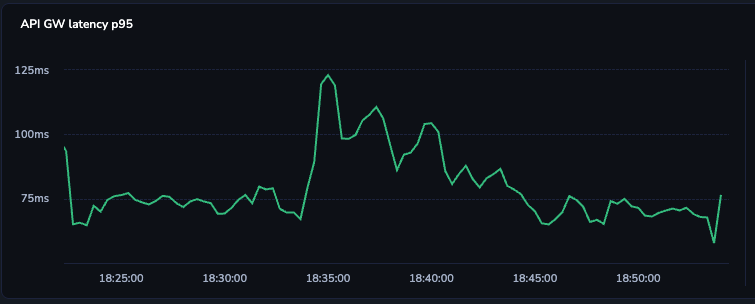
These figures validate our ability to support real-time production workloads where latency budgets are strict, including LLM agents, real-time moderation systems, and conversational UIs.
Architecture Optimized for Speed and Accuracy
Our ability to achieve sub-120ms latency isn't accidental; it's the result of architectural choices designed specifically for real-time enforcement.
Key design elements include:
- Lightweight model ensembles tuned for both throughput and precision.
- Hardware-aware routing and auto-scaling to absorb bursts of demand.
- Precompiled detection pipelines covering the full range of safety dimensions.
- Early exit conditions to accelerate benign classifications.
- Language-agnostic token normalization to handle diverse, multilingual inputs.
Together, these optimizations allow guardrails to maintain speed without compromising on detection accuracy or breadth of coverage.
Conclusion
Our benchmarks prove that WonderFence consistently meet sub-120ms latency SLOs across languages and input types, fast enough to keep pace with the most demanding real-time AI applications. But the numbers are only part of the story.
What they really mean is that the flow stays unbroken. A player can stay immersed in a fantasy world. A customer can feel reassured by their virtual banker in a stressful moment. A traveler can get instant, safe guidance from a chatbot on the way to their gate.
Low-latency guardrails make safety invisible, catching risks before they surface, without interrupting the rhythm of conversation. They are the stagehands behind the curtain, making sure every interaction feels instant, natural, and trustworthy.
Want to understand the techniques that make this possible?
Watch our on-demand webinar: Distilling LLMs for Safer, Production-Ready AI.What’s new from Alice

Guardrails Without Changing Your Agent Code: ALICE WonderFence Is Now a Databricks Unity AI Gateway External Policy
ALICE WonderFence is now a Databricks Unity AI Gateway External Policy. Attach it once in Unity Catalog to screen every governed model call, no SDK, no code changes.

LIVE from Black Hat Las Vegas: AI, Nation-States, and the Battlefield That Keeps Changing
Recorded live at Black Hat, Caroline Wong and Allie Mellen unpack why AI made nation-state attacks cheaper, why safety guardrails can work against you, and what the OpenAI-Hugging Face incident really exposed.

Virtual Fireside Chat: The TAKE IT DOWN Act, Six Months In - What's Changed on Deepfakes and NCII
Six months after the TAKE IT DOWN Act took effect, the NCII landscape looks different and even more complicated. Join Alice for a live fireside chat with Google's Nidhi Lahoti on what's actually changed, what hasn't, and where T&S fit into it all - Watch on demand

5 Ways Your Third-Party CX Agent Gets Broken
Third-party CX agents create hidden liability. Learn the 5 attack patterns vendors miss and how WonderSuite closes the gap.